technical services
We develop practical, data-driven solutions to complex sustainability challenges. Our work often involves designing innovative tools and methods tailored to each client’s priorities and operating context.
Carbon and Water Footprints
We help organizations complete carbon and water footprints that are aligned with global standards and guidance, such as the GHG Protocol and ISO 14064. Our team has extensive experience calculating and reporting Scope 1, 2, and 3 greenhouse gas emissions for companies seeking to meet customer and regulatory requirements, as well as industry and investor expectations.
We support clients from the earliest stage of setting reporting boundaries, to identifying input data needs, collecting data from across the business and supply chain, and defining appropriate assumptions, through to final, verified results ready for reporting and internal decision-making.

Source: WRI/WBCSD Corporate Value Chain (Scope 3) Accounting and Reporting Standard
Review and Verification of Carbon Footprints
Independent review and verification enhance the credibility, accuracy, and usefulness of carbon footprints for regulation, investors, and internal stakeholders. Secondary reviews and third‑party assurance help identify methodological errors, data gaps, and overly optimistic assumptions in complex Scope 1, 2, and 3 inventories, and provide an objective assessment against standards such as the Greenhouse Gas Protocol and ISO 14064.
In an environment where external assurance is increasingly required by law and expected by the market, we conduct independent reviews and third‑party verifications that help clients avoid greenwashing, align emissions data with the rigor of financial reporting, and give investors, regulators, and business partners confidence that reported carbon figures are complete, comparable, and decision‑ready.
Life Cycle Assessments
We support clients in conducting Life Cycle Assessments (LCAs) to understand environmental impacts of production, from raw material cultivation/extraction through manufacturing, transport, use, and end‑of-useful‑life. LCAs identify impact “hotspots,” often revealing counter‑intuitive drivers such as use‑phase energy or embedded water in upstream materials, and help direct effort toward the most effective interventions. They also support corporate reporting frameworks, including the GHG Protocol, science-based targets, and environmental product declarations. As regulators move toward life‑cycle‑based disclosures customers are prioritizing product footprint data, building LCA capability prepares organizations for future compliance and reduces greenwashing risk.
While a number of tools can deliver LCAs at scale or “real‑time” product assessments, we focus on targeted support for singular products or small portfolios, especially for companies just getting started, or where results are needed to answer specific questions about a product or process.
Our experience spans a wide range of products and processes, including apparel and other consumer goods, reused and resold products, packaging, and related systems.

Material Flow Analyses
Clients seeking a wholistic picture of a product's life cycle, from its distribution through use and disposition at the end of its useful life, are given insights into quantitative aspects that support business decisions and meet regulations to drive viable circular solutions.
Combining life cycle assessment (LCA), material flow analysis, and techno-economic expertise, we analyze the potential scale of environmental and economic benefits where circular pathways are established and develop a high-resolution estimate of where waste can be most economically recovered and processed. We then analyze options for reuse and recycling, including the carbon impacts of redistributing recovered materials.
Our material flow analysis is a novel method to estimate the likely distribution of waste materials along with a detailed analysis of where the waste might be economically processed and reused/recycled. To see an example of our work, explore the material flow analysis conducted for the Gypsum Association.

Custom Material Ranking Tools
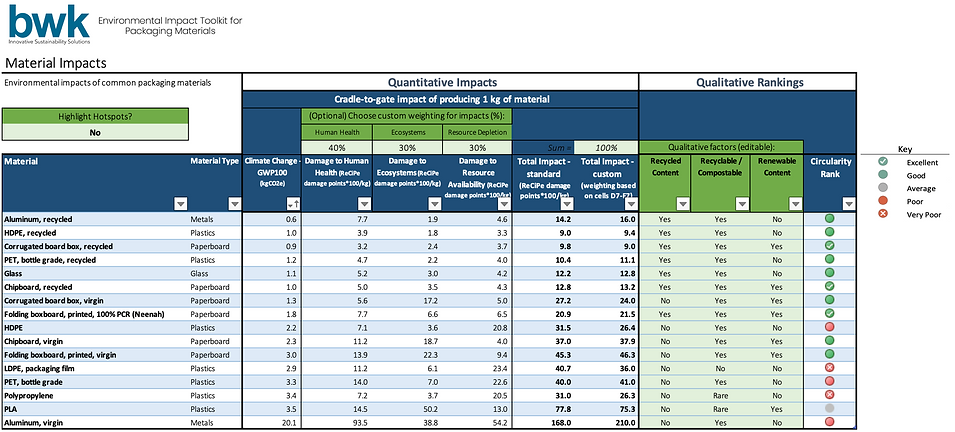
Our data-driven material ranking tools help organizations make informed purchasing decisions regarding raw materials and packaging that reduce environmental impact while supporting sound business performance.
These tools are built on cradle-to-gate life cycle assessment data and an individualized methodology developed together with the client, reflecting their mission, culture, and key issue areas.
The output is an internal reference guide that provides comparative data to support sourcing and product development teams.
Material toolkits typically combine quantitative and qualitative scoring, with the capability to evaluate:
· Impacts on human health, ecosystems, and resource availability
· Global warming, eutrophication, water consumption
· Chemistry, recyclability, compostability, and reusability
· Certification status of suppliers and materials
· Additional indicators including microplastics, renewable content, and regenerative farming practices
Each material receives a relative impact score to support side-by-side comparisons and informed sourcing decisions. See how we created a Material Ranking Toolkit for Aveda and how it helped their indirect purchasing team make more informed decisions.

Custom Environmental Impact Calculator
Our environmental impact calculators provide another way to evaluate material choices and product configurations. Like material ranking tools, they assess material characteristics to inform purchasing decisions, with an added capability to build and compare custom product specifications. This allows users to determine which combinations of materials and quantities best align with their preferred environmental outcomes.
Clients have used these calculators to:
-
Quantify greenhouse gas emissions and water savings associated with resale of products such as apparel, handbags, jewelry, and watches
-
Identify packaging configurations that minimize environmental impacts across broad product assortments